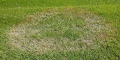
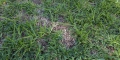
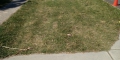
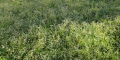
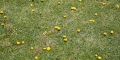
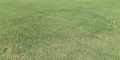
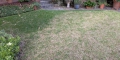
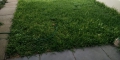
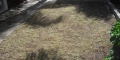
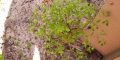
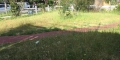
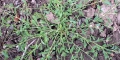
Spring Dead Spot is a lawn disease which is most noticeable as presenting with large brown patches that develop on the surface of a Couch (aka Bermuda) lawn, these brown patches will be between 10 centimetres to a metre across, and will be most noticeable as Spring Dead Spot rather than any other lawn disease by the brown patches actually being sunken in nature, as if the patch of sod affected not only died away but also sunk lower into the soil.
As the name suggests, Spring Dead Spot will become most noticeable in the Spring, and will reappear constantly year after year and can spread out to other parts of an affected lawn to create more dead patches in the turf. The disease first takes hold in Autumn and will over-winter until the Spring arrives when it will again become active and spread.
The pathogen affects the root system and crowns of the Couch lawn as well as the rhizomes and stolons, but instead of killing the grass the disease will continue to feed off it to the point that the lawn becomes so weak that it can no longer survive, and this dying away in patches will often occur during subsequent Winters when it is no longer strong enough to live through tougher climate conditions.
Fungicide Treatment Of Spring Dead Spot
Once again, as mentioned about other lawn diseases, a fungicide treatment is most often never enough to treat Spring Dead Spot either. Instead multiple treatments of a suitable fungicide will most likely be necessary, alongside other cultural management practices, with every aspect of treatment working together towards an overall cure.
University researchers in the United States have found that Autumn is the best time to apply fungicide treatments to treat Spring Dead Spot in Couch lawns, with this treatment time determined after following the lifecycle of the disease and how it’s affected by changes in soil temperature.
Reapplication is usually done every 28 days, though this can be bought down to 21 day intervals if it becomes necessary to apply a further treatment due to any sudden cooling down of temperatures due to the approach of Winter.
The most serious of those within turf disease management sciences will base all of their exact treatment times for Spring Dead Spot on soil temperatures alone.
As this disease not only affects the leaf and stolons and crowns above ground, but also the rhizomes and roots below ground, a fungicide treatment which is enough to soak the entirety of the turf and thatch layer is necessary, and also enough of the treatment should be applied to go into the soil as well.
This is an overview of the recent science behind treating Spring Dead Spot, and for the homeowner past this point they should be reading carefully the instructions of the product manufacturer of the fungicide they’ve purchased to help combat this lawn disease.
Following the instructions of the fungicide manufacturer first, while keeping in mind some of the recent research being conducted as the best means to treat Spring Dead Spot.
Other Cultural Management Practices
We can only follow the general guidelines for treating all lawn diseases. That we combat the disease on many fronts at once, while strengthening the lawn itself to naturally help fight off the disease and to recover from damage.
Fungicide has already been covered.
Adjusting watering habits can also help, but watering only in the mornings, watering less often but more deeply.
Removing any excess shade from the lawn area will also help, especially as Couch lawns have very low to no shade tolerance at all. This will help the lawn stay healthier overall, as well as aiding the lawn to dry away moisture from its thatch layer more quickly.
A good ongoing lawn fertilising program throughout the year is always highly recommended to keep lawns strong and healthy, and will also help the lawn to combat this lawn disease too.
Lawn coring to aerate the lawn soil may also be of benefit.v
Other research has suggested that vertimowing the Couch lawn may also aid in treating and curing Spring Dead Spot.
Like all lawn disease, we never want to think for a moment that there is a single magic bullet, there never is. Rather we need to treat the lawn in many ways, simultaneously to defeat this very nasty lawn disease.
Pathogens of Spring Dead Spot
Australia and USA: Ophiosphaerella namari
USA: Ophiosphaerella korrae and Ophiosphaerella herpotricha
Present in:
Couch grass: presenting as Spring Dead Spot
Zoysia grass; presenting as Spring Dead Spot via Ophiosphaerella korrae in USA
Kentucky Bluegrass: presenting as Necrotic Ring Spot